Showing posts with label endurance. Show all posts

Wednesday, January 22, 2014

Coconut Butter: My Secret Weapon For Endurance Fueling & Recovery

Coconut Butter: My Secret Weapon For Endurance Fueling & Recovery

Secret Training Techniques Of UltraPedestrianDo, Part Two
(The Way Of The UltraPedestrian)

photo by Chihping Fu
by Ras

     You may never have heard of coconut butter before, but it has become widely available in recent years. Coconut butter differs from coconut oil in that it is the whole meat of a ripe coconut finely ground into a paste, similar to peanut butter or almond butter. Coconut butter is in no way related to cocoa butter, which is made from cocoa beans. Coconuts are the fruit of a variety of palm tree, whereas cocoa beans come from the fruit of the cacao tree, a relative of cotton and okra.

     Coconut butter is extremely palatable and flexible as a food (try stirring two tablespoons of coconut butter and two teaspoons of curry paste into simmering veggies and serve over rice). But my interest in it is as a fuel. I have been eating coconut butter for two years now, and it has helped fuel me for my biggest accomplishments, including my Double Wonderland and Grand Canyon Rim to Rim to Rim to Rim to Rim to Rim to Rim adventure runs.

     Medium Chain Triglyceriedes The main benefit of coconut butter as a fuel for endurance athletes is its fats, which are Medium Chain Triglycerides. MCTs are a unique form of dietary fat that impart a wide range of positive health benefits, including helping control appetite, boosting immune function and purifying blood (due to its lauric acid content), stimulating metabolism, promoting calcium absorption, and regulating blood sugar levels. 

     But the most important thing about MCTs for endurance athletes is that they are immediately metabolized and used by the body, not stored as fat, as Long Chain Triglycerides are. According to Ward Dean, MD, and Jim English, "MCTs are an especially beneficial supplement for fueling physical exertion, given their high energy density content, rapid rate of absorption and quick metabolic conversion into cellular energy. Additionally MCTs can be quickly mobilized in the post-exercise recovery phase to rebuild muscles and prevent the breakdown of proteins (catabolism) that can occur when the body is putting a maximum demand on the body’s energy reserves." (From NutritionReview.org)

     Training Your Body For Fat Fueling This makes coconut butter an ideal food for training your body to metabolize fat. I make an effort each morning to make the first thing I eat high in healthful fats in order to switch on my body's fat prioritization. A couple spoonfuls of coconut butter is perfect for this because it is palatable and easy to eat. It can also be spread on toast in place of butter, or stirred into hot cereal or oatmeal, among myriad other uses.

     Low Oxidation Rate Because coconut butter oxidizes slowly it does not go rancid. It can be  stored unrefrigerated for up to two years. Coconut butter lasts and carries well for extended backpacking trips, and will easily survive an extended stay in a drop bag or food cache.

     Very Low Cost Per Calorie Perhaps the best news of all regarding coconut butter is its incredibly low cost per calorie, as little as $8.00 for a jar containing over 2800 calories. Compare that to specially marketed energy gels, where $8.00 will buy you at most 600 calories. For shorter runs I package a 200 calorie serving in small baggies or plastic wrap, twist the top shut and seal it with a small piece of tape. For multiday efforts I melt the coconut butter and pour it into a resealable plastic jar and eat it by the spoonful directly from the container. 


     Coconut butter is readily available from any natural foods co-op or health food store, including the big chains. It can also be ordered from natural food retailers on line, or made at home from scratch. Artisana has recently started packaging it in single serving pouches, which are convenient for short trips.

Saturday, January 18, 2014

Fartlek Fridays: Strongly Speedwork For Fine Tuning Those Fast Twitch Muscle Fibers

Fartlek Fridays: Strongly Speedwork For Fine Tuning Those Fast Twitch Muscle Fibers

Secret Training Techniques Of UltraPedestrianDo, Part One
(The Way Of The UltraPedestrian)

photo by Chihping Fu
by Ras

     Despite the humorous english homonymics, the Swedish term "fartlek" means "Speed play". Goodness knows I enjoy a play on words, as evidenced by my use of 'strongly' instead of 'weekly' to refer to doing something once every seven days. But the importance of speed work is serious, even if my choice of terms has an amusing sound.

     If you want to get my attention, using the word 'fart' is a great strategy. I admit it. I'm an overgrown manboy who still believes a scatological reference is the best way to maximize a statement's comedic potential. And I'm no where near mature enough to overlook a syllable in a foreign language word that has a potty-talk phonetic analog. (As an example of just how immature my sense of humor is, please note that the word 'analog' contains both the word 'anal' and the word 'log'. I rest my case.) So when I happened upon the term fartlek, needless to say my interest was peaked.

     'Speed play' just plain sounds fun, and it's supposed to. 'Workout' has the word 'work' in it, which carries burdensome implications, and it also describes a long and uncomfortable process of coming to terms with a situation. 'Speed play' sounded like the perfect way to work out my issues with speed work, so I decided to give it a go. 


     Speed work can train the body and mind to move more quickly and do it more efficiently. Your physiognomy can adapt, producing increases in aerobic threshold, lactic acid processing, and fast twitch muscle fiber recruitment. This information is easy to find with any web search, and difficult to avoid in running magazines. But it never seemed applicable to my running until I read Adam Lint's trip report for his Wonderland Trail FKT in 2011. Nearing the end of his 93 mile run he says:

Next began an intense 4ish mile climb up to Mystic Lake.   This is where I began to feel the distance that I had put on my legs as it felt like an 8 mile climb.  Since my fast twitch muscle fibers were still fresh I decide to do 30 second intervals (sprints) with a one minute break in between just to get my ass to the top of this climb.

     I had never done speed work of any sort until a year ago. I run simply to enjoy running. I don't have a formal running background, so speed work was something foreign to my experience. I would read articles about its importance, and the science and reasoning made sense. But as soon as a work out would be described in mathematical seeming terms, my mind would just wander to another topic. (In high school I had a math class in a room that was painted light blue and it would put me to sleep just about everyday. As a result I seem to have a conditioned response to fall asleep when I see numbers.)

     I began Fartlek Fridays the beginning of January 2013. On March 30 I set a 100 mile PR of 27:17 an improvement of almost two hours. Two weeks later I again improved my 100 mile Personal Record by running a 26:44. A week after that I set a 50k pr of 5:35. Then a world record at the Grand Canyon. Then a 200 mile PR. You can read all the details in my 2013 Year In Rear View. But the only thing I was doing different in my training was running Fartlek Fridays. 

     Kathy pointed out to me that these claims are correlative and anecdotal. I pointed out to Kathy that this article was for publication by UltraPedestrian.com, not PLOS ONEIn the interest of full disclosure I should state that I am a high school graduate and junior college drop out. I do not have a background in medicine, nutrition, kinesiology, biomechanics, physical therapy, or anything else that would grant credence to my words. My background is in doing what I dang well please and not being overly concerned with how other people feel about it. But I do monitor and evaluate my performances, and I attempt to replicate my successes.

     Here's my basic fartlek workout:

15 minute warm up, running very easy

10 sets of running a hard & fast interval for 90 seconds, then running a very easy recovery interval for 90 seconds: 3 minutes total = 1 set
1 bonus set of super skips for 90 seconds
15 minutes cool down, running very easy


     Important Note: I do not push or force myself during the hard & fast interval. I focus on perfect running form, and allow the technique to produce the speed. My goal is tall, engaged posture; completely relaxed legs, ankles, and feet, everything from the knee down; forward lean at the ankles, not the waist, to produce what is essentially a long, controlled forward fall; and very rapid foot turnover, 180 strides per minute, resulting in a rapid and light footstrike. During the hard & fast interval, all my mind is doing is going over the above mental checklist and counting strides. I count strides like a waltz: one-two-three, two-two-three, three-two-three, four-two-three. If you build this technique, the speed will come. 

copyright Altra Zero Drop Footwear

     Super skips are essentially just what they sound like: skipping by means of a technique designed to propel you as high and far as is reasonable. This is accomplished not by pushing hard off the ground with your back leg, but by swinging your front leg and the opposite arm up to a 90 degree angle explosively. Again, use your mind to guide your body in letting the technique do the work.

     My Fartlek Fridays are actually rather rigid in their structure, but I enjoy it and it works for me. The same session could be done without a watch, using landmarks and self awareness. Pick a tree or powerpole or fencepost and run the hard & fast interval to it. Then run very easy until your heartrate and breathing level out. When you feel ready to make another concerted effort, look ahead and pick the next landmark. Or perform a quick internet search and you'll find a wide variety of different fartlek sessions.

     Beyond their very definition as play, fartleks are somewhat free form in nature, allowing me the flexibility to customize my work out each week according to my needs, physical condition, and mood. On days when I don't feel 100% or am lacking motivation, fartleks aren't intimidating. I tell myself, "It's just fartleks. Go out and do what you can and have fun with it." But I invariably end up doing my full session as well or better than usual. 

     I instituted Fartlek Fridays because I like alliteration, but it turns out that Friday is the perfect day to do speed work. Since most races are on Saturday or Sunday, I can easily skip a Friday work out immediately before a race without throwing my entire schedule off. And five or six days later, when Fartlek Friday rolls around again, I'm recovered enough to push myself, but can allow myself the flexibility to back off my effort as my body demands, all while still fulfilling my training goals.

     Future articles will explore the overall application of alliteration as the basis for a training plan. Here's to hoping that Mixed Martial Arts Mondays and Trials Bike Tuesdays will reap as many benefits as have Fartlek Fridays.


Wednesday, September 4, 2013

UltraHiking the Devil's Dome Loop

UltraHiking the Devil's Dome Loop:
Kathy Vaughan & Lisa Eversgerd

photo by Lisa Eversgerd


photo by Kathy Vaughan
By Kathy Vaughan


     The Devil's Dome Loop in the Pasayten Wilderness  is a rugged 45 mile loop with 12,000 feet of elevation gain. It travels through the high country along Jackita Ridge with views of Jack Mountain and its massive glaciers in sight the whole way. Then the trail drops down to Ross Lake on steep terrain, grown over with brush  and with hidden rocks and holes underfoot. It is a beautiful route. My trekking partner on this adventure is a long time forest service trail crew supervisor, who claims it is probably the most scenic trail she has traveled in the Pasyten.


photo by Kathy Vaughan

     Lisa Eversgerd and I became fast friends last winter after we went on two different ladies ski trips together into the Rendezvous Huts outside of Mazama, Washington. We skied into a cabin with a group of other ladies, and Lisa and I hit it off immediately. To use her words "we are like two peas in a pod". Both vegan, outdoorsy adventurers, we are at ease with each other whether chatting away or moving for miles at a time in silence. We would ski with the other ladies in the morning and then continue on our own journey for hours and miles beyond what the others were interested in. We would get back to the cabin at dark, warm up, eat and pull out our crafting projects. Lisa makes amazing pine needle baskets that she creates with her strong, yet agile fingers stitching and forming the shape so effortlessly. I enjoy making little dolls out of recycled wool and other natural scrap fabrics. This is a perfect way to relax and recover after long endurance efforts.

photo by Lisa Eversgerd

     I first backpacked around this loop with Ras about 15 years ago. It was our first trip of this sort together. We had rented everything we needed for this excursion, except for the hiking shoes Ras was wearing, which he referred to as his "trail posers." We were newbies in every sense of the word. We bathed with soap in the beautiful mountain stream, carried 1 gallon plastic water bottles strapped to the outside of our packs for our water supply, and naively pitched a tent on the side of a steep switchback trail, our first night out. We hadn't left the trail head until 6:00 that evening. Needless to say, I have learned a lot since those days.
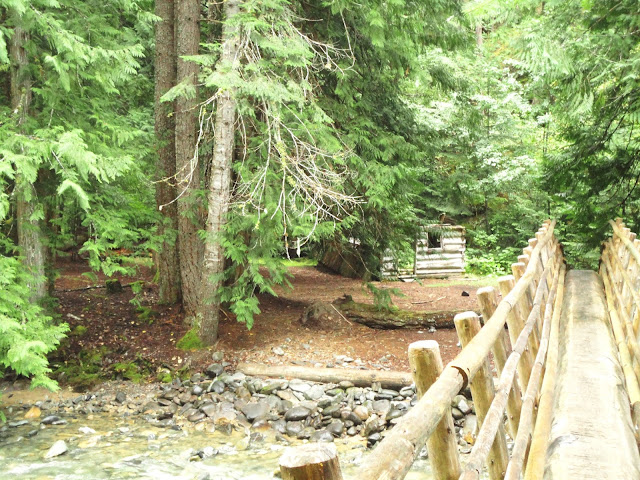
photo by Kathy Vaughan

     Lisa drove her little truck with a canopy on the back into the North Cascades, a 4 hour drive from our nearby homes in the Okanogan Highlands. We made stops along the way so she could check on her pine needle baskets that she sells at the Main Street Market in Omak and the Mazama Store. She also makes wonderful herbal soaps and she needed to restock the supply at the Main Street Market. When we got to the Colonial Creek Campground in the early evening, it was pouring rain. We set up a little dry spot in the back of her truck, and made our final pack preparations for the next day's adventure. I had made a delicious tempeh scramble dish, which I reheated at the campground and we shared a nice meal together while keeping dry. After the rain let up, we found a dry spot under some huge cedar trees where we could pitch our tents. We crawled inside and slept well under rainfall until the early morning. The rain let up for us as we made coffee and got dressed. We had about a 15 minute drive to the trailhead at the East Bank of Ross Lake. Here we parked, let out excited cries of "Let's Do This" and were on our way.

photo by Kathy Vaughan

     We first took a few switchbacks down to the bridge that crossed the aqua marine colored  confluence of Panther & Ruby Creeks. After making a few minor adjustments we began our rolling 3.3 mile hike of the Ruby Creek Trail. Our feet got immediately wet from the rains the night before soaking the brush that was growing over the trail. They would stay wet for the rest of this 45 miler. We had light packs with everything we would need loaded into them and we would do this hike in one push, thinking it might take us around 20 hours.

photo by Kathy Vaughan

     After this section of trail, the climb began for real. It would continue to climb for the next 20 miles. Rain came in little sprinkles here and there, so we kept our packs covered to keep our warm night layers dry. At the last minute, I had grabbed a little 99 cent yellow rain poncho to bring with me, because of rain in the forecast. I had a more substantial rain shell, but I thought this might come in handy as well. This is what I wrapped around my pack to keep it dry and it became one of my most useful pieces of gear. It just goes to show that the cost of an item does not indicate its true value on the trail. I didn't mind being wet from the rain as I was staying more than warm enough from the climbing. 


     The sun came out occasionally and blue sky would open up. We could still see the incredible views of the distant peaks, despite the rain clouds that came and went. When we finally got up into the high country after a few hours of climbing, we entered a wild blueberry patch that was filled with berries. I fell behind Lisa as I kept grabbing berries as fast as I could, popping the little delicious bites into my mouth, realizing that I could never buy something so special as this at our local markets. The berries were plump and juicy and had a slight apple flavor mixed in with the blueberry. Nature's candy!

photo by Kathy Vaughan

     Lisa and I enjoyed taking breaks as we hiked, sitting and replenishing ourselves in scenic spots when we would find the perfect rock or log. I felt awesome, eating a lot as I went to keep my energy level up. I knew we had many miles to travel and the right nutrient and hydration balance would be the key to staying positive and strong. I am very happy with how this aspect of our trip went. I ate tempeh I had cooked ahead of time; nuts and nut butter pouches; Gu Chomps; figs that Lisa shared; dark chocolate with espresso (especially at night); pumpkin seeds with roasted garlic salt; soy jerkeys and Cliff Bars. I never got too hungry.

photo by Kathy Vaughan

     I had brought my Sawyer Squeeze water filter and it was easy to find sources all along the trail. I enjoy stopping alongside a creek to filter water, being grateful for the cold, natural source and being able to take care of other needs while stopped. Lisa is so used to being on the trail and working with a crew, that I always feel like we are a real team. She helped with the water filtering each time and insisted on carrying the filter after our first stop. She was always tuned into what I was doing or needing; she had my back and I had hers. There is no other way to be when you travel deep into the wilderness with someone. I felt comfortable with her, at ease, and like I could always just be myself. I get a little giddy on the trail after many hours. I could embarrass myself with this behavior, but with Lisa she just laughed.

photo by Kathy Vaughan

     After topping out at 7,000 feet on Jackita Ridge, the trail travels down a steep shale slope. I had done this trail twice before and both times this slope had lingering snow. Not this time. We cruised down the shale with no issues as we dropped deep into the valley of the North Fork of Devil's Creek. It felt good to be going down hill. I was holding up well with my consistent eating and drinking. The downhill trek was technical, steep and slippery. Soon we could see Devil's Dome ahead, our next climb to gain a 7,000 foot summit. This climb was relentless, but when we reached the top, 24 miles into our hike, it was time to have a rest and put on our warm night layers. I took off my wet short sleeve short and put on a cozy, dry Smartwool  sweater. I also put on a warm wool blend hat with a Smartwool neck gaitor over the top for extra warmth in the night. Dusk would fall on us as we descended. Our 12.5 mile trek along Ross Lake would be in the dark. The tread would be more mellow at that point and headlamps would give us the light we needed to make our way back to Lisa's truck at the trailhead.

photo by Kathy Vaughan

     As we followed the trail downhill, we pushed our way through wet brush once again. It became increasingly hard to see the trail at our feet with the coming darkness and the brush obscuring obstacles, but before we knew it, we were down to the lakeshore. After 4 miles, we came to the Devil's Creek suspension bridge and took advantage of the flat surface to take another break. We had a magical stop here, with the creek far below us, emptying into Ross Lake. It was quiet and still and we were alone in the woods. The only critters we saw were huge toads and a backpacker, sound asleep, who had set up his sleeping bag in the middle of the trail.
  
photo by Kathy Vaughan

photo by Kathy Vaughan

     It was perfect and I was overwhelmed by the understanding now of why ultrarunners run 100 milers again and again. After my first 100 miler, Pigtails Challenge in May, my first question to Van Phan, an ultramarathoner, local legend and the race director of Pigtails, "Why do you 100 milers go out and do this again?" Now I know. During Pigtails, my night miles were often under street lights, or other runners were coming towards me with their headlamps, or I could hear cars going by. I had special and wonderful moments on that journey as well, but traveling through the night on trail in the middle of nowhere is a different experience all together.

     Because of this quietness, the sleepiness hit Lisa and I on this final stretch down Ross Lake. We first tried to play games like Ras and I would play with our daughter Angela when we took her backpacking as a little girl. I suggested we play the ABC game (I had also tried this during Pigtails, but my brain would not work efficiently enough). We went through the alphabet, taking turns saying boy's names. Then we came up with girl's names all the way through the alphabet. Then last names, until we got tired of this and were too tired to keep going. 

photo by Kathy Vaughan

     Lisa did it first. We had stopped and sat on the trail to snack and make some adjustments. We both changed into nice dry socks. She laid down and turned off her headlamp. She was still and quiet. I was still rummaging through my pack with my headlamp on. When I finished, I decided she looked very comfortable and I would lay down too. Soon, we were asleep. This began our power nap pattern. We would walk for as long as we could, and then simply lay down on the trail and sleep for 10 minutes or so. We would be hiking along and suddenly my breathing would become shallow, like I was laying in bed and falling asleep. And then I would begin to have little dreams and stumble around on the trail. I had heard of this. I had heard of ultrarunners sleeping on the trail, especially Ras. Now I got it. I not only got it, I enjoyed it and looked forward to each nap I would get to take as we traveled along.

photo by Kathy Vaughan

     We were making progress though and we had passed the last major camp along Ross Lake, Roland Creek Camp. I knew this camp and its creek crossing well. I had camped here a couple of times in the past and I was very familiar with this section of trail. The final 7 miles. Woo Hoo!! We got some water from the creek, napped and then crossed. We were on the final stretch. We had one little climb left and then a 2 mile section along Hidden Hand Pass. We meandered along this pass, until struck with the drowsies once again. We laid down for what we thought might be our final power nap. 

     When we awoke and began moving again, I began to feel disoriented. Dawn was approaching now. Instinctually, I felt like we were somehow moving in the wrong direction. We should have been done with the pass and now moving down hill again to the final stretch along the lake; a 3 mile long old road bed where we would make excellent time. It would be light out. We were almost done.  We would nestle in the back of Lisa's truck. We would have a cup of coffee and some hot soup. All at the same time, a loud relentless downpour started, pounding against the salal and Oregon Grape; a wide creek that needed fording came into view; and ahead was a wooden sign post.  I knew what I was looking for but what I saw were the words "Roland Creek Camp". Lisa recognized the creek too. It was now light out and very wet. We were 7 miles back up the trail. What wrong turn did we take? What loop is this that brought us back here? What the heck did we do? Oh no, where is my toilet paper-right now, really?

photo by Kathy Vaughan

     "Patience is a virtue, a wait won't hurt you and in the long run, it will serve you." At this point, that's all we could do; be patient, with ourselves, with each other, with the trail and our journey. We just started moving to keep warm in the cold morning rain storm. We were quiet for about 15 minutes as we started back along that stretch of trail for the 3rd time, now much more awake. Soon we started laughing and joking about it and before we knew it, we were back at the bridge, and up the few switchbacks to the truck. Now the rain stopped and we could make that coffee we so wanted. I spread my cheezy yellow rain pouch on the ground.

     I stripped off my sopping wet layers and wrapped them up in the "Yellow Wonder" as it had been named. There is nothing so heavenly as putting on fresh, dry clothing after a long day on the trail.  I looked down at my watch. We had just completed the Devil's Dome Loop in a straight through hike in 26:24, including all of our breaks, power naps and water filtering time.  Lisa had never hiked over 22 miles in one shot. She doubled her distance PR (personal record) and had her first experience of going all night. She kept her spirits up the whole time and took great care of herself. With our additional mileage, we figure we hiked about 50 miles. I can't wait to see what is in store for us in our next adventure together.

photo by Lisa Eversgerd


Gear List:

Peter Bakwin Ultimate Directions Vest
Zensah Calf Sleeves (Bright Pink and fresh out of the package)--These kept my lower legs warm through all of the wet brush and also helped keep my calves from tightening up with all of the climbing.
Black Diamond Ultra Distance Z Poles--I love these poles and highly recommend them for use on steep terrain.
Altra Lone Peaks 1.5 Running Shoes--My feet held up well and they provided good traction on the technical terrain.
Salomon Running Skort--The lightweight fabric was perfect in the rain and wet brush. It did not become heavy and dried quickly as soon as the sun hit it or the run stopped.
Black Diamond Headlamp
GoMotion Sternum Light--I have mixed feelings about this light. I like the extra light it provides, but the light itself will not stay fixed in one place. I had to fiddle with it a lot.
Injinji Toe Socks--Merino Wool are my favorite
Innov8 Gaitors
Western Mountaineering Down Puffy Suit--Very warm and great for power napping before the rain started in the early morning, as its not waterproof.
North Face Rainshell--warm and waterproof


NEXT UP: A review of my favorite piece of gear on this trip, my new Peter Bakwin Ultimate Directions ultrarunning vest.

Wednesday, July 17, 2013

The AltraPedestrian Project Rebooted: Installment zero1.5

The AltraPedestrian Project, Rebooted: 
Installment zero1.5


photo by Takao Suzukiby Ras

     In the reggae dancehall scene it's common for a singer to have the band or DJ play the first few bars of a song and start to sing, then call, "Pull up!" At that point the band or DJ stops the music (the DJ manually spinning the record backwards with his finger), returns to the very beginning of the song, and starts again from the top. This is called a Pull Up or a Wheel Up. So if you imagine the AltraPedestrian Project being a reggae riddim, this is me calling to the DJ, "Wheel up and Come Again, My Lord!"
photo by Ras
Classic Lone Peak 1.0 on the left, updated Lone Peak 1.5 on the right.

     My original plan was to track the life of my newest pair of Altra Lone Peaks and document all the mileage I put on them, taking photographs along the way to show how they are faring. (See The AltraPedestrian Project, Installment zero1) But Altra threw a monkey wrench in my plans when they sent me a pair of the new, updated Lone Peak 1.5s when I only had a little over 350 miles on my new pair of classic 1.0s. Now, admittedly, a lot of shoe manufacturers recommend replacing their shoes when you get near the 400 mile mark. Really? Every 4 races I need new shoes? Every few OKTs I need new shoes? Every other month I need new shoes? I don't think so, and, apparently, neither does Altra.


photo by Ras

     But, alas, I am fickle and love shiny new things. And the new Lone Peak 1.5s are VERY lovable, especially if you already had a thing for the original 1.0s. The upgrades are few enough that the shoe is still recognizable both in appearance and feel, but substantial enough that the difference between the 1.0 and 1.5 is noticeable, and that one can easily develop a preference for the 1.5s. And the 1.5s seem to run a little bit larger than the classics, which to me, a size 14, feels truer to size.

photo by Ras

     In appearance alone many differences are immediately obvious. The new color scheme is red on red for the men's, rather tame compared to the safety orange and lime green of the women's 1.5. It retains it's throwback styling, yet manages to look up to date, while avoiding the Cabbage Patch Kid vibe the 1.0 occasionally evoked. Graphics and gusseting are both pared back a bit, giving the 1.5 a slightly lighter and more nimble feel. And noticeably missing from the heel is the homage to the Tarahumara (Raramuri) People, "Run on the Earth and with the Earth."

Kathy in the new Women's Lone Peak 1.5 by Altra Zerodrop

     However there are three new things on the heel. A tab of nylon webbing has been added to help pull the shoe on, although I can't recall having actually used it. The Z trademark and "Zero Drop" text as well as an Altra logo all stand out day and night in reflective bright white. And the new integrated velcro gaiter anchor is a cool innovation. Altra gaiters are rumored to be available later this year. And ever present is the mysterious trail rudder. I have to admit that I'm fond of this ineffable piece of outsole physiognomy, despite having no idea of its function.
  
photo by Ras

     Another distinctive feature kept in tact on the Lone Peak 1.5 is the footprint design on the outsole. When I get comments on this during races it reassures me that my form is decent. At least, I know I am lifting my heels high enough for people behind me to see the bottoms of my feet. I enjoy how easy it is to spot this design, not only on the feet of runners ahead of me in lemming lines, but in prints on the trail as well. I always know when there are Altra's about. 


photo by Ras

     As of these photos, the classic 1.0 had run the Badger Mountain Challenge 100 miler, Lumberjack Endurance Runs 100 miler, the Spokane River Run 50k, 126 miles in the Grand Canyon, and 10 training miles for a total of 367 miles. The new Lone Peak 1.5's had run the Sun Mountain 50 miler, the Pigtails Challenge 200 miler, and 24 miles of training runs for a grand total of 274 miles. I would characterize the 1.5 as still being a little bit stiff, not completely broken in. And that's as it should be. The Lone Peak is designed to be a shoe for 100 mile races, so 300 or 400 miles should far from do them in.

photo by Ras

     The wear on the inside of the heel cup shown on the Classic Lone Peaks (above left) is not uncommon, as attested to by numerous Lone Peak runners. Both pairs of my 1.0 have shown this wear, but have never caused me any sort of irritation or blistering or chafing. As can be seen in the photo above, the new liner material shows none of this wear. The upper is also made from a softer and more flexible material for a slightly more comfortable fit.

     So that's my initial impression of the Lone Peak 1.5s. I've only got 274 miles on them so far (although the plan is to add another 100 + this Sattaday), so I'm still just getting to know the updated model, but so far we're getting along just fine. All of the updates are purposeful and well thought out and seem to be functional improvements. But the character of a beloved shoe remains in tact.


Friday, April 12, 2013

This Is Your brain On Your Very Humanity Itself


This Is Your Brain On Your Very Humanity Itself

Wherein I address the question, Can Trail Running Develop into an Unhealthy Addiction?


photo by Kathy Vaughanby Ras

   When I first read the above question, I presumed the operative word was 'addiction'. And the place that trail running holds in a livicated runner's life, to the outside observer, can easily be construed as such. Trail runners often need to run more and more to have the desired experience. When the person does not run they experience unpleasant side effects, frequently the opposite of those of trail running. They have difficulty cutting back, even if it's strategic tapering. Social, occupational, and/or recreational activities become more focused around the trails. Trail runners become preoccupied with running, spending increasing amounts of time planning, engaging in, and recovering from trail adventures. In short, many trail runners display the hallmarks of addiction in their relationship with running.

     Beyond mere appearance, for all intents and purposes running affects the brain like a controlled substance. Or, more precisely, like two controlled substances: opium and marijuana. 

     During intense physical activity opioids are released in a runner's brain. These compounds, although produced within the human body, activate the same receptors in the brain as does ingesting heroin. Opioid receptor activation can help to blunt pain. It can also affect the reward centers of the brain, increasing the release of dopamine causing pleasurable feelings; feelings of bliss, well-being, elation, euphoria.

     Forty-five minutes to an hour of moderate running produces elevated levels of cannabinoids, molecules that activate the brain's cannabinoid receptors. These are the same receptors that the THC in marijuana activates, producing similar results. Runner's high indeed.

     Another seeming link between running and addiction is in the therapeutic realm. Timothy Olson has been brutally, and commendably open about his struggles with addiction and the role that trail running has played in that battle. Running would logically seem to function as methadone, taking the place of the addictive substance. But I would posit that it serves more as a higher power.

     However, 'unhealthy' is truly the operative word in that question. Whether running can be an addiction or not is immaterial. Trail running predates the cultivation of poppies or marijuana or any other form of agriculture. It predates religion. It predates human speech. Trail running is an essential and quintessential human activity, an artifact from the savannah, from when we were just distinguishing ourselves from the broader designation of 'hominid'. 

     Trail running cannot become an unhealthy addiction because it is neither unhealthy nor addicting. It is a proto-human behavior, a thing so deeply ingrained in us that the two cannot be seperated, we from it. And there's little profit in accusing us of being addicted to our own humanity. 


Thursday, March 21, 2013

Running Local: It's a Beautiful Day in the Neighborhood


Running Local: It's a Beautiful Day in the Neighborhood


photo by Ras
By Kathy Vaughan


     Hitting the ground hard, I was now suddenly both awake and surprised. I had tripped on the frozen, rutted mud only 2 minutes into my 31 mile self-supported training run. I had no choice but to shake it off, my right knee and elbow now skinned. I was due to meet my friend and running partner Shona Hilton and there was no time for delays. She would join me for some middle miles on this day of running. She lives just 5 miles away at the other end of the dirt road I live on with my husband Ras. This road is called Dry Gulch and it goes through quite an array of conditions throughout the year. The area is the Okanogan Highlands of North Central Washington at 3,500 feet in elevation.

     Right now, we are experiencing spring break-up. Snow has been covering the ground for months and now the temperatures are warming. Dry Gulch is great for driving when its compact snow and ice, manicured regularly and sanded by the snow plow driver. It then goes through a muddy stage when the snow melts, where even the best 4-wheel drive has to be fought with to keep on the road. After the mud dries, it leaves deep ruts, freezing at night in the early spring. During the day it becomes dust, referred to by locals as “moon dust”. Next comes the crazy “washboard” a wavy, rutted road surface which causes you to fishtail if you get up to even 30 mph.. The road is then horrible for running. A passing car kicks up more dust than is safe to breathe. The grader works to repair the washboard throughout the spring and summer, but dust is always there.

     On this day, the conditions were actually great for Dry Gulch. Frozen in the morning, the mud would be soft by mid day. Enough of the road had dried out that I could choose whether or not to run in the mud. My plan was also to get off of Dry Gulch for part of the run. I would enjoy some time on the forest service road that neighbors the 40 acre piece of property where Ras and I live in a rustic lodge we caretake. There is wonderful running, biking and cross-country skiing on this road, which doubles as a section of the Pacific Northwest Scenic Trail. Locals head up the road in the wintertime on snowmobiles. This makes a great pack for running or skiing. I was looking forward to running on it after some dirt road miles, knowing it would feel softer on my feet and be awesome to get away from any possibility of a passing car. Unfortunately, my favorite trails were still too snowy for running.

photo by Kathy Vaughan

     Earlier in the week I had been looking at my Bryon Powell Training Plan for a 100 Mile Race. I noticed that at the end of Week 14 ,which I was currently in, I would need to run a 50k distance. Not being signed up for an official 50k race, it would be up to me to put together the route and run it on my own. Ras would be busy working his job as a carpenter, so he would not be able to join me. Pigtails Challenge 100 Miler around Lake Youngs in the Renton area, my first 100 mile race, was happening Memorial Day Weekend no matter what. I was determined to stick to my plan. It was actually fun to brainstorm all of the possible routes I could run to reach that mileage goal. I knew my biggest challenge would be to stay motivated for all of those miles on my own. Mixing up the terrain would be key to keeping it fun.

     The morning was cold and quiet as I ran. I soon saw Shona up ahead, moving towards me as we had planned and that made me smile. She called out “Good Morning” in her cute, Scottish accent. We kept on running to the end of Dry Gulch and then turned alongside a little creek, now visibly flowing after being covered in a layer of ice all winter. In the summer, cows range freely in here, mucking up the creek. It begins to smell like cow pies and the creek water is greenish brown. Right now, the water was looking clean and fresh, running through the snowy banks along its sides. This area would change drastically in only a few months. 

photo by Kathy Vaughan

      Shona and I could see Bonaparte Mountain off in the distance and we chatted about the Bonaparte Ultra Ras and I are putting together for the weekend of July 6th. What distance will we run? We should do hill repeats to train for the big climb to the lookout. We can run it faster this year with another season in us. Isn't it cool that Van Phan and Deby Kumasaka want to come run it? (Huge inspirations to Shona & I, Deby ran seven 100 milers last year and Van won the Washington Grand Slam & the women's division of the Pigtails Challenge 200 miler) They'll love it! . . . .  Ultra runners often spend at least some of their time running talking about other ultra runs they want to do and other ultra runners. Its pretty normal.

     We were on a 3.2 mile out n'back section. Then Shona would run back towards my car/aid station with me on Dry Gulch, to her turn around point. We could see the hardy neighbor ladies up ahead, regular walkers no matter what the weather, both in their early 70's. It took a while to gain on them and I was impressed with their pace. Nothing goes unnoticed in a country neighborhood and sure enough one of the ladies had seen me run by solo earlier and wondered why I now had a partner. One of their dogs was pretty unfriendly towards me, so Shona and I said goodbye and went our separate ways.

photo by Kathy Vaughan
M.O.N.T. member and training partner Shona Hilton

     In less than a mile, I was back to my car. I drank half of a refreshing Red Bull, one of my indulgences during endurance efforts, and then decided to get my dog Jesse from the house. He would be fun to have along for some miles, but he was getting too old to join me for all 31. He was very happy indeed and we took off to run the other end of Dry Gulch road, a 4 mile out n'back section. We passed by Eden Valley Guest Ranch in its idyllic setting and another creek, flowing swiftly with snow melt. When I got done with that 4 miles, it was time to hit the snowy forest service road. Jesse loves this kind of running, so it would be fun to keep him with me. I'd completed a little over 15 miles at this point in my run.

photo by Kathy Vaughan

     I spent 2 ½ hours in the forest, running on the snowmobile pack. Sometimes the snow was too soft and one or the other foot would sink down up to my knee, “postholing”. This would sometimes catch me off guard and I would fall. I actually enjoyed this though and settled into the idea that my traveling was now quite a bit different than it had been before. The sun was shining. I felt warm and comfortable. I could see young, bright green pines coming up in the old burn area where I was now running. Off in the distance, the rugged and rocky face of Haley Mountain was towering over the scene. I wondered about an access trail to the summit. I was moving towards its base and would then turn, running a 5 ½ mile lollipop trail through forest service land. Some of this trail is a part of the Highlands Halloween Hundred Trail Adventure Run (H3) that Ras and I hold Halloween weekend in October. I took a short break in here, nibbling on a nut mix.

photo by Kathy Vaughan

     The snow continued to soften as I ran. By the time I got out to Dry Gulch again, I was postholing on almost every step. I welcomed the road. I was happy with how my Altra Lone Peak trail running shoes were performing in these mixed conditions, transitioning easily from helping me keep good traction in the snow & mud, to giving me the support I needed on the hard pack dirt. I ran ¼ mile or so to get back to my car again. Each time I got there, it was easy to change out water bottles or clothing layers, have something to eat, and resupply my Nathan running vest with Cliff Blocks, nuts and new Perpetuem bottles (a liquid, vegan nutrition drink I can easily sip while running, made by Hammer Nutrition). 

     I felt just right all day in a hat and gloves. I dried my sweaty gloves out in the car between visits. A merino wool sweater with a thermal running hoodie was necessary, even though the sun kept poking through. There was enough of a breeze to keep it a little cool all day. Now it was time to run Jesse back up to the house. The driveway was muddy and snowy. Intermittent puddles made for creative footing. This was the most technical section of the run! Our driveway is ¼ of a mile long, so this would add a half mile onto my route. Jesse was ready to be done and he went inside to lap up some water and lay down on his cozy bed. I was off for more running.

photo by Kathy Vaughan

     Now I would repeat the 4 mile section of Dry Gulch. I felt good and relaxed, the benefits of so many hours of running through nature. With the spring melt, birds were returning to the highlands and I had seen my first robins and mountain bluebirds of the season. A bald eagle was perched high in an aspen, watching for the afterbirth the cows had been leaving behind. The sweet melodies of meadowlarks were nice to hear throughout the dirt road running. The mountain chickadees were singing their tunes also, preferring the forest with its large fir & tamarack trees.

     I needed some more mileage after my 4 mile out n'back, so I went back up the snowy road into the forest service land. I felt grateful to be able to mix up the terrain I was running on and enjoy the quiet peacefulness that I felt as soon as I entered the forest. I ran up the road for ½ hour and then turned around. Back at the driveway, all that was left of my adventure was to check the mailbox ¼ mile away, run up the messy driveway and back down the final ¼ mile to the car.

     The calm of late afternoon was surrounding me now. I felt a stillness in me like this time of day has, when activity comes to a close and dusk has not quite settled. The remaining daylight brought with it a sense of everything being just right. I had finished my self-supported ultra training run. It had been really fun and not as challenging as I thought it would be. During this same season, 2 years ago, I was just beginning trail running. I would steadfastly refuse to run the driveway at the beginning and end of runs for some reason, no matter how much Ras gently prodded. Now as Ras pulled up, finishing his work day, he was just in time to see me come running down the muddy driveway, a coincidence we could not have planned. 

     Done running for the day, I could now go in by the woodstove, warm up and cook a delicious meal of tofu scramble. Its really awesome being able to put together my own ultra distance run right out my front door. Turns out, staying happy and engaged in a run in my own neighborhood is not a problem after all.

photo by Ras


My Ultrarunning Gear/Favorite Stuff List:
  1. Nathan running vest (I have 2 sizes, depending on the distance & support available)
  2. Nathan hand bottle with a spare bottle (or 2) filled & packed in my vest; if I will be filtering water, I bring a Sawyer water filter
  3. Nathan 10 ounce flasks with Hammer Perpetuem, each flask holding a 2 hr. supply
  4. Justin's nut butter pouches; baggies of nuts or seeds; peanut butter sandwich on sprouted grain bread; homemade peanut butter & dark chocolate energy ball; avacado
  5. Clif Blocks (although I'm currently switching to Gu Chomps for the amino acid benefit)
  6. Injinji toe socks (completely prevents blisters for me)
  7. Altra Lone Peaks trail running shoes (zero drop design has been great for ankle stability & healing)
  8. Smart Wool quarter zip, mid-weight merino wool sweater (perfect for layering, year round)
  9. Brooks Thermal Running Hoodie (awesome warm outer layer with pocket for mp3 player)
  10. KT brand kinesiotape (taping on both ankles has been giving me great support & confidence after having been prone to ankle rolls)
  11. Black Diamond Z Poles (for runs with lots of climbing)
  12. mp3 player loaded with Raggae Dancehall mixed tapes


photo by Kathy Vaughan


photo by Kathy Vaughan


photo by Kathy Vaughan


photo by Shona Hilton


photo by Kathy Vaughan


photo by Kathy Vaughan


photo by Kathy Vaughan


photo by Kathy Vaughan


photo by Ras