2013: The Year In Rear View


I couldn't have asked for a fuller or more rewarding year than 2013. It was an amazing year to be a human being. I achieved epic wins and suffered epic fails, exceeded my own expectations and fell short of my own goals. It was a year of extreme highs, yet it was a year of balance. There were corresponding lows that maintained equilibrium.
This year I began learning the value of failure. Not to embrace it, not in the least. Failure will never be met by me with a resigned handshake. Failure will always get my fangs and claws. I will only enter into it with kicking and screaming and flailing; with wailing and gnashing of teeth. But in those instances where my best efforts fail to ward off defeat, there is so much to learn; about myself as a specific individual, and about us, humankind as a whole.
And in many ways failure is the goal. The only way to know for sure that I am pushing the boundaries of my own capabilities is to occasionally overstep those bounds and plummet into the abyss on the other side. So along with detailing a year of incredible triumphs, I will tour you through a few desperate chasms, as well.
Being chosen as an Altra Ambassador really helped take my running and adventuring in new directions. I had discovered Altra Zero Drop Shoes by googling various descriptions of the features I was looking for in running shoes, and Altra kept coming up. I bought a pair of Lone Peaks and have run in nothing else since. The support and confidence Altra showed in me, a quirky back of the packer, was both humbling and inspiring. And it showed the broad-minded vision of the company's leadership, which includes sponsoring thru hikers as well. And I'm stoked to be representing Altra again for 2014.
It was only my second time ever attempting the 26.2 mile distance when I ran the Fort Ebey Kettles Trail Marathon on February 17th. Leading up to Fort Ebey I had been running fartleks every Friday, the first time in my running career I've ever focused on speedwork of any sort. My finish time of 05:29:53 for 10th Men's and 12th overall seemed to show that Fartlek Fridays were reaping benefits. Here's the complete race report: Fort Ebey Kettles Race Report
I surprised myself with a 100 mile PR at the Badger Mountain Challenge 100 Miler on March 30th. My finish time of 27:17 was a big improvement over my 29:02 PR at the 2011 Cascade Crest 100 Miler. Matt Hagen insists that the course at Badger was a few miles short this year, but I took a wrong turn and added a few miles (with a steep climb), so I know mine was a legit 100 regardless. Here's the complete race report: Badger Mountain Challenge 100 Miler
Kathy gives a Crew & Pacing Report on the Badger Mountain Challenge in episode #001 of the UltraPedestrian Podcast here: UltraPedestrian Podcast Episode #001

Two weeks later, on April 13th, I set another new 100 mile PR of 26:44:00 at the Lumberjack Endurance Runs 100 Miler. Kathy gives a Crew & Pacing Report on the Lumberjack Endurance Runs in episode #003 of the UltraPedestrian Podcast here: UltraPedestrian Podcast Episode #003
Seven days after Lumberjack, on April 21st, at the Spokane River Run 50k I set a new 50k PR of 5:35:08. Fartlek Fridays start sounding a little less silly at this point.
A fortnight later, on May 4th, I began the 68 hour and 10 minute odyssey that was my World Record Rim to Rim to Rim to Rim to Rim to Rim to Rim, that being the first ever sextuple crossing of the Grand Canyon. One of the hardest and most enjoyable things I've ever done, the R2R2R2R2R2R2R got me noticed on a level that I was not expecting. It was not as difficult as my 2012 Double Wonderland, but the Grand Canyon is a bigger stage. And just a couple days after I completed my run, Rob Krar blew the collective mind of the trail running community with his stellar Rim to Rim to Rim Fastest Known Time, further focusing public attention on The Big Ditch, as many are want to call it. My complete trip report is here: Grand Canyon Rim to Rim to Rim to Rim to Rim to Rim to Rim
The complete recording of my talk at Seven Hills Running Shop about my Grand Canyon Triple Double Crossing is here: UltraPedestrian Podcast Episode #002
The TrailRunnerMag.com interview Tim Mathis conducted with me is here: Ras Vaughan's Unsupported, Sextuple-Rim-to-Rim
The GrindTV.com article is here: Trail runner is first to complete sextuple Grand Canyon crossing
Ken Michaels interviewed me for his podcast Running Stupid, direct download here: Running Stupid CXXIII (Ras Jahson Ites Interview)
And Ian Corless interviewed me for Talk Ultra here: Talk Ultra: Episode 36 - Ultrapedestrian Ras, Calitz, Kremer, Davies, Cardelli, Browy

Two weeks after finishing my Grand Canyon run I ran the Sun Mountain 50 Miler. I was still very tired and only partially recovered from the triple double Rim to Rim, but I wanted to run this race as part of a two race project that I was calling the Sun Pig Mountaintails Challenge 250, which entailed running the Sun Mountain 50 Miler on Sunday, May 19th plus the Pigtails Challenge 200 Miler starting Thursday, May 23rd, for a total of 250 miles in one 7 day period. I struggled all day, was DFL for a number of miles, then managed to pass two people in the last two miles of the race to finish in 12:45:01, my slowest 50 mile finish ever. For comparison, in 2011 I finished this same race in 9:45:53.
Three days later I started the Pigtails Challenge 200 Miler. At this point I was 1/5 of the way into my Sunpig Mountaintails Challenge 250 miler, and 1/3 of the way (mileage wise) into my attempt at completing the WA Super Slam. This was another long-term project of mine, running all the longest distances at all the 100+ mile races in the Washington Grand Slam With Ham. So my goal was to run the Badger 100, Lumberjack 100, Pigtails 200, Cascade Crest 100, and Plain 100. I had run the Pigtails 200 its first year, in 2012, and was one of only two finishers from the first year returning, Ken Michaels being the other. Unbeknownst to me, I had contracted giardiasis from drinking tainted water in the Grand Canyon (completely my fault, and a risk I knowingly took at the time).
It hit me for the first time about 4 of 21 loops into the Pigtails 200. I completely lost my appetite, and my digestion seemed to stop working. A very small amount of food or liquid would make me feel immediately stuffed, and would produce ridiculous amounts of gas from both ends. My stomach was bloated and distended and felt over full all the time. Throughout the rest of the 67 hours and 27 minutes total that I was on the course I ate very little. When I tried to lay down and rest on two occasions I just tossed and turned for an hour and a half or so, never getting any quality rest or relaxation.
When Allen Skytta joined me as a pacer on lap 20, I was filling my water bottles with half Coke and half water, which was all I could manage to take in as a calorie source. At this point I was in 4th place overall with Francesca Carmichael in front of me, putting me in 3rd place for the Men. This would be my first podium finish ever. Then about halfway through lap 20, the second to last loop, Ken Michael appeared out of nowhere from behind us and with George Orozco pacing him. They passed us with Ken giving his trademark "All Day!" greeting. I watched their headlamps disappear ahead into the night, and it just didn't sit right in my mind. Not only was Ken breezing past me to take away my first ever (and possibly only ever) podium finish, but he was being paced toward that goal by a good friend. I suddenly found myself thinking, "No." I turned to Allen and said, "Let's not let those two out of our sight," and started running, trying to match their speed. Allen grinned and slapped his hands together, and the race was on.
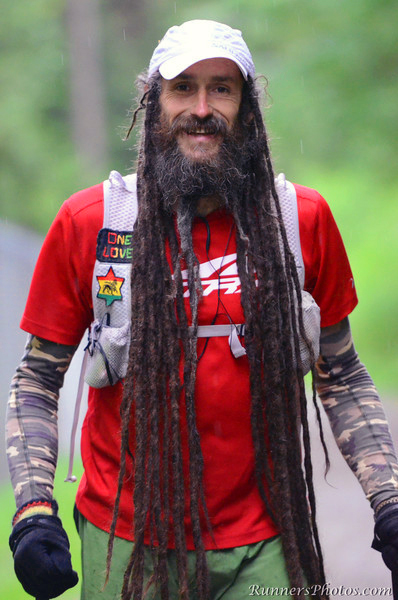
We turned off our headlamps so Ken and George wouldn't be able to tell exactly where we were and caught up to within about 50 yards of them, then just hung on. We discussed strategy for the turn around. I planned on dropping my trekking poles, refilling with Coke and water, and getting back out as quick as I could. Allen told me Ken and George would be doing the same. We were both in and out of the main aide station within a minute or so. Allen had to get ready to take over the midway aide station, so I was on my own.
I was able to keep about the same 50 yards back from Ken and George for the first two miles of the 9.6 mile loop, on a couple of occasions stopping behind bushes in well-lit areas in hopes of keeping my two friendversaries literally in the dark about how far behind I was. As we were nearing the first real climb of the final clockwise loop, I found myself catching them up without meaning to. I tucked in behind them and matched their pace, running quietly and not knowing if they knew I was there or not. Finally George said, "Nice work, Ras," and I speedhiked behind them, matching their pace as they jogged up the hill. George said to Ken, "If we don't do something now, when we get to the downhill he's just gonna take off and we'll never see him again," but at that moment Ken didn't seem to have anything to answer with. After a minute Ken said, "Ras, I guess we can run it out and cross the finish line together."
I said, "Well, I don't mean to sound like an a******, but I don't think that was your plan a few minutes ago, so let's just see how it plays out," pulled around them on the left, and ran off up the hill at about 98% effort, and into the rolling section where George know I would make up time on the downhills. Ken and George had doused their headlamps as well, so now I couldn't see how far behind they were. I was running all the downhills and flats as fast as I could and even running many of the uphills. At the midway aide station Deby Kumasaka refilled my Coke & water mix, and I sped on. She later said she could see the fire in my eyes and knew something was up.
Throughout the rest of miles 195 through 200, I would catch the occasional glimpse of my pursuers in the form of a silhouette on the crest of the hill behind me. I was passing friends heading the other direction so quickly that I couldn't recognize them in time to say hello. I know I startled a couple of people emerging suddenly out of the darkness and disappearing again into it just as quickly.
I have spent a lot of time running in the dark without a headlamp, to a great degree by feel, so the ambient light of the city of Kent was plenty for me to see by. And although I was haunted by fleeting glimpses of my pursuers, in the end I took that final podium spot with a 1:55 final lap to Ken's 1:57. This gave me a finish time of 67:27:00 to Ken's 67:29:00, and a new 200 mile PR for me by just under two hours.
The Pigtail Challenge was also Kathy's first 100 mile race. Her complete race report is here: 2013 Pigtails Challenge: My First 100 Smiler
Race Director Van Phan's Race Director's Report is here: Pigtails Challenge 2013
James Varner's 100 mile race report (including a sighting of my and Ken's 21st lap battle) is here: Race Report: Pigtails Challenge 100

After Pigtails I was incapacitated by giardia. My weight plummeted to 170 lbs. I usually walk around at about 190. Even in the UltraPedestrian Video that Tim Cash made for us, you can see that I am abnormally thin. For all of June and July I was unable to run. If you look at my Altra Ambassadors Page you can see that I had to pass up at least four Only Known Time attempts I had planned for 2013. To this day I still do not feel 100%.
I only got in two or three short training runs before August 11th and the Angels Staircase 60k, which was to be my final tune up race before the Cascade Crest 100, and the Plain 100 three weeks after that, the final two races in my WA Super Slam attempt. I love this course, and had a great time, but my running was labored and forced and difficult, and I wasn't all that happy with my performance. And it didn't bode well for the two 100 milers I had coming up. I finished with a time of 10:22:51, 45 minutes behind last year's time.
On August 24th, I struggled through every step of the Cascade Crest 100. I am a very meditative runner. I usually float along for miles, for HOURS, in a zen endurance fog, moving easily, almost on autopilot. But not this time. Every stride, every minute, every step of the Cascade Crest 100 miler was an effort. It was never easy or cruisy or floaty or zen. It was work and pain and exertion and a constant sensation of moving through a viscious fluid, or against elastic bonds. I finished, and I made the 32 hour cut off, but not by much. I turned in my personal worst 100 mile time of 31:38:30 and took home my third CCC buckle in as many years. And I had completed 500 of the 600 miles of my WA Super Slam. But I was not feeling optimistic about the upcoming Plain 100, and I only had 21 days to be as ready as I could be.
On September 15th the Plain 100 became my first Did Not Finish. It's easy to brainstorm a long list of excuses, but they don't change the fact. I failed to complete the Plain 100, thus failing to complete both my personal WA Super Slam and the official Washington Grand Slam With Ham. It's okay to say it. I failed. Yes or no, did I accomplish what I set out to do? No. Fact.
The supreme challenge of the WA Slam is that the toughest race, the Plain 100, is the final race in the series. And it is just two or three weeks after Cascade Crest, the second toughest race in the series. This year, when it counted, I was unable to meet that challenge. I did, however, still qualify as the only finisher of the 2013 Washington Grand Slam Hold The Ham, that being completing four out of the five 100+ mile races held in Washington state. Here are the complete results of the Washington Grand Slam With Ham: WA Grand Slam With Ham
Over the summer we hosted the first annual UltraPedestrian Wilderness Challenge, an adventure blogging contest we dreamed up as one step in the ongoing UltraPedestrian goal of Democratizing Trail Culture. Read the complete results here: 2013 UPWC Complete Results & Awards
October 5th my entire family ran the Baker Lake Ultras. I ran the 100k and Kathy and Angela both ran the 50k, it being Angela's first organized race of any sort. I came in at 16:20:26 for my first ever 100k finish, Kathy ran an 8:24:23 for a PR on that course, and Angela finished her first ultramarathon in 7:36:11, officially making us an Ultra Family. Kathy's complete race report is here: 2013 Baker Lake 50k Trail Run: Third Time is a Charm

On October 18th Kathy and I set out to attempt a North to South to North double traverse of the Kettle Crest Range via the Kettle Crest Trail No. 13. Due to significantly more snow that we had hoped, 100+ blow downs across the trail, and significantly more elevation gain than we knew of, we called it quits at 6:43AM on October 19th after 46+ miles, 23 hours and 56 minutes on the trail, and the Garmin measuring 19,000 feet of elevation gain (although I find this number suspect). However, our North to South Traverse of the Kettle Crest stands as the Only Known Time for the complete Kettle Crest Trail No. 13. Kathy's complete trip report is here: Kettle Crest Traverse: North To SouthThe Fastest Known Time page detailing our attempts on the Kettle Crest is here: Fastest Known Time: Kettle Crest Trail
The Second Annual Highland Halloween Hundred Trail UnRun, aka H3, was hosted by Kathy and I on October 26th. Distances of 42 miles, 84 miles, and 126 miles were offered. This was another of our efforts to redefine endurance and build new paradigms of hominid locomotion. Kathy's complete Race Director's Report is here: H3 2013: The Second Annual Highland Halloween Hundred Trail UnRun
November 18th Kathy and I ran the Baker Lake Fat Ass 50k. Our goal and intention was to run the 100k, but after 50k in 4 inches of fresh snow, rain all day long, standing puddles on the trail, temperatures in the upper 30s, rising winds, plummeting windchill, and 11 hours and 12 minutes on the trail, we tapped out. Terry Sentinella was kind enough to give us a 50k finish. Kathy's detailed trip report is here: Baker Lake: Take Two
On December 15th Kathy and I ran the Deception Pass 50k together for the third year in a row and the third year of the race. Kathy and I finished in 8:21:05 and 08:21:06, respectively (yeah, she outkicked me by a second at the end there).

Also in December, I won a Grimey Award. It was an honor to be selected as one of the honorees for the first annual Washington Ultra Grimey Awards. Thank you to Tim Mathis, also to Trey Bailey of UphillRunning.com. And I'm in excellent company. Read all the awards here: 2013 Washington Ultra Grimeys
What an amazing year and what a Blessing to be alive! Give Thanks for Life!
